Traveling Turkeys
Delivering our Signature Traveling Turkey Baskets to
over a thousand deserving families since 2009.
Cleveland, MO 64734
ph: 816-365-3238
crystal


Recent Developments
Recent Developments:
February 14, 2012
The ALS Therapy Development Institute to Launch Phase II Clinical Trial of TDI 132 in ALS Patients
CAMBRIDGE, MA– February 14, 2012 - The ALS Therapy Development Institute (ALS TDI) will launch a Phase II clinical trial on TDI 132 (aka: fingolimod/Gilenya®) as a potential treatment for ALS (Lou Gehrig’s disease). Fingolimod is currently being marketed by Novartis AG as Gilenya® as a treatment for some forms of multiple sclerosis.
To register to recieve more information about this trial as it becomes available, complete a form here: http://www.als.net/media/als132/
August 1, 2007
Robert and Crystal Cram on KCTV5 News
There was an update in gene research in ALS and KCTV5 News wanted to do some coverage. They asked Robert to put a face to ALS. They came to our home to interview us and we were able to help explain how devastating ALS is. The headline: ALS, or Lou Gehrig's disease, is a deadly condition striking the nerve cells that control muscle function. Researchers have now identified genes that could help solve the mystery of ALS.
http://youtube.com/watch?v=PWapaCHpP2k
May 16, 2007
Advocacy Update
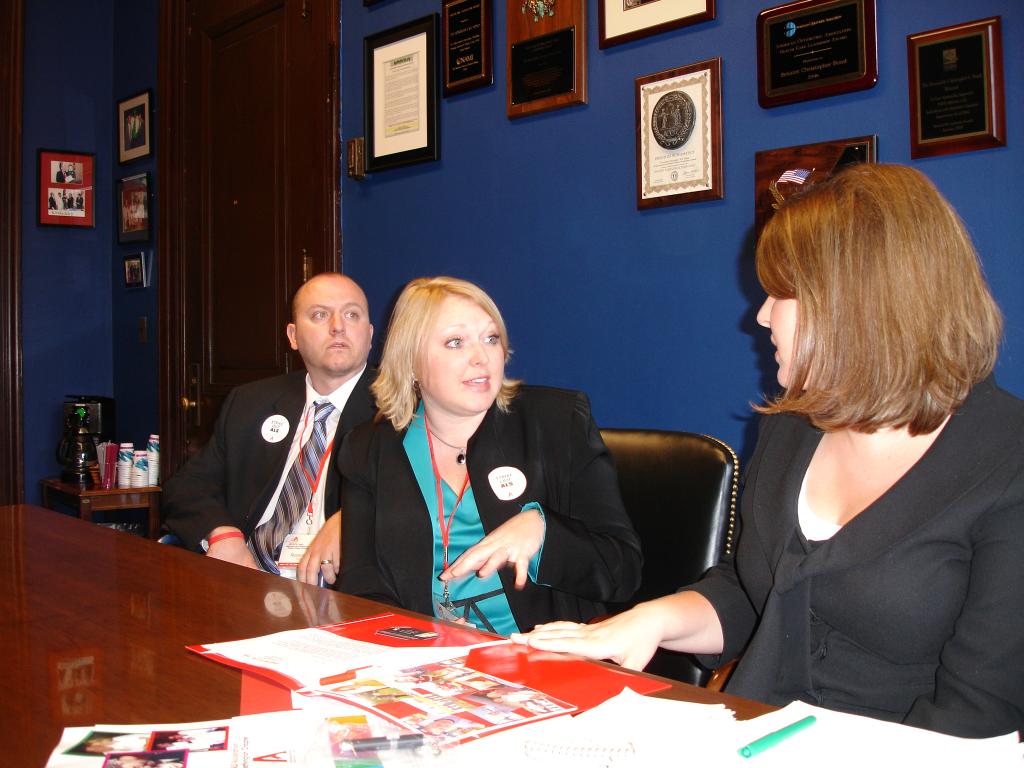
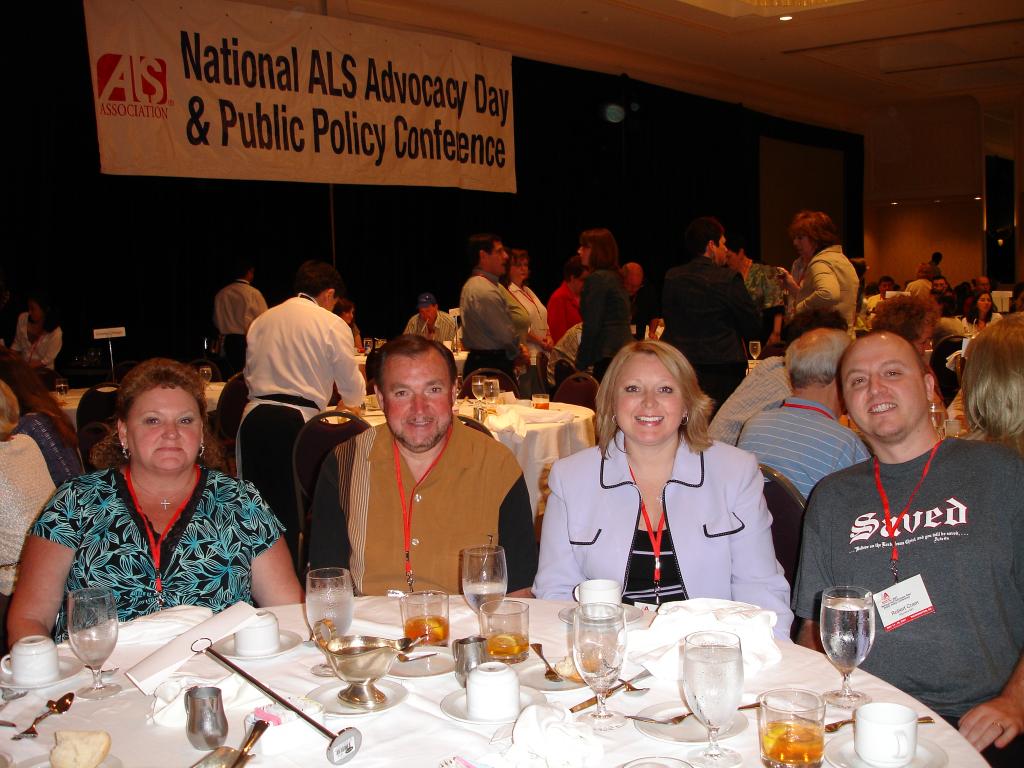
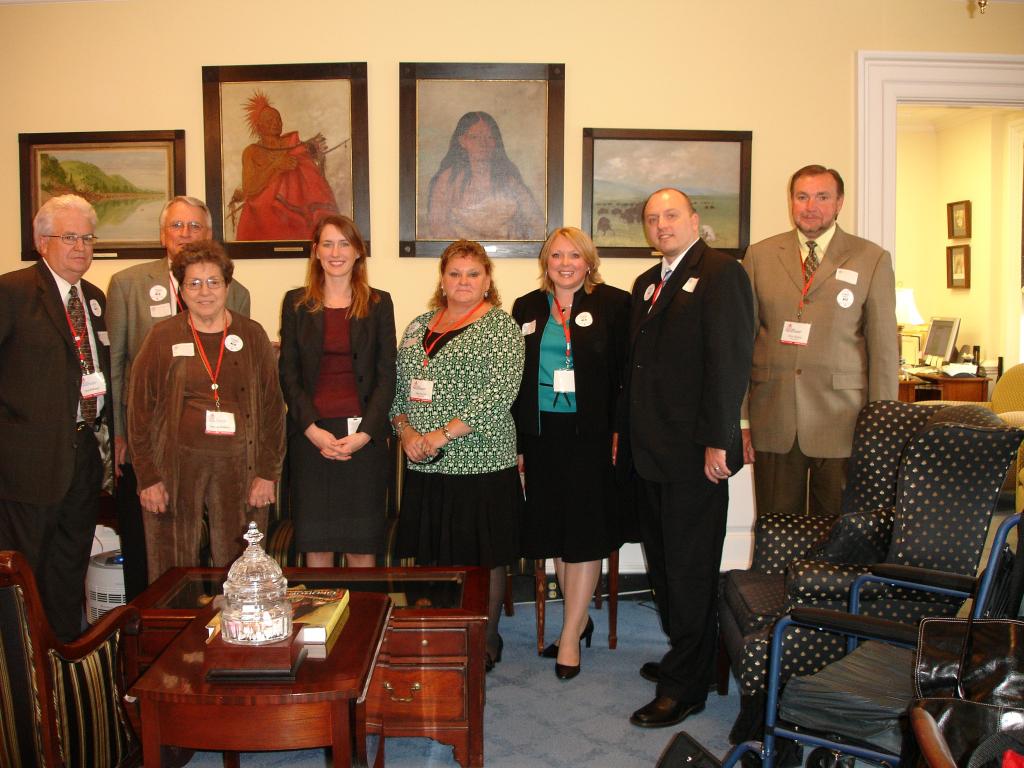
Robert and Crystal Cram meet with Congress
The Crams are pleased to share with you that at Washington DC conference the week of May 14th, The ALS Association called on Congress to sponsor bills including an ALS Registry Act and a Department of Defense bill that will allocate funding for more research. There were over 600 advocates and 120 ALS patients in D.C. for the conference on ALS and congressional meetings.
The Crams had meetings scheduled all day on May 16th, speaking with Senators and Representatives, and their assistants from the State of Missouri. It was a very fulfilling and inspiring experience they are glad they were able to be a part of. Crystal shared their personal experiences of diagnosis and life changes they have made during the last year since diagnosis, while Robert made quite an impact showing strength while struggling with physical changes with his body. It was emotional at times but overall it went very well. Hopefully their testimony will give all a better understanding of this horrid disease.
They were able to meet House Republican Whip Roy Blunt in his office in the Capitol Building. He listened to their story and expressed his concern and gave his commitment to help. Fortunately, Rick and Nita Stubbs were able to attend the conference with the Crams. This was support and assistance the Crams greatly appreciated. Rick was able to push Robert around DC in his rented wheelchair, which is something Robert was thankful for as Rick is a much better driver than Crystal.
The Crams and Stubbs both agree this was a wonderful event they are glad they were able to participate in and they have plans to be involved in the ALS Conference again next year. They will do everything they can to help Congress realize they must take action to bring new treatments to help Strike Out ALS.
April 19, 2007
Advocacy Update
The ALS Association Testifies Before Congress
The Advocacy Department is pleased to share with you that at a Capitol Hill hearing earlier this week, The ALS Association called on Congress to speed ALS drug development and ensure that people with the disease have timely access to new treatments. The Association was invited to testify at an April 17, hearing of the House Energy and Commerce Committee, Subcommittee on Health, which has jurisdiction over several of The Association’s top public policy issues, including the ALS Registry Act and the Food and Drug Administration. The Subcommittee convened the hearing to examine the reauthorization of the Prescription Drug User Fee Act (PDUFA), legislation designed to provide additional resources and funding to the FDA to help expedite drug reviews.
The Association was the only patient organization invited to testify at the hearing, which also included witnesses representing the FDA, the Pharmaceutical Research and Manufacturers of America (PhRMA), the Biotechnology Industry Organization (BIO) and Consumers Union. Jim Thew, a PALS and advocate from Chicago who is featured in The Association’s ALS Awareness Month campaign, testified on behalf of The Association. A 35 year-old father of three and Navy veteran, Jim educated the Subcommittee about the disease and shared his personal experiences living with ALS. Jim’s testimony provided Members of Congress with a better understanding of the true nature of the disease and why Congress must take action to bring new treatments for ALS from the lab to the bedside as soon as possible. Jim’s testimony to Congress is available by clicking here or www.alsa.org/policy/article.cfm?id=1106.
April 16, 2007
Embryonic Stem Cells Show ALS Can Arise From Support Cells
[Quick Summary : Experiments with mouse embryonic stem cells show that the supporting cells of the nervous system, if mutated, can kill motor neurons in a cell culture, providing a new and powerful tool to develop therapy for ALS.]
Researchers funded by The ALS Association at Harvard laboratories led by Tom Maniatis, Ph.D., and Kevin Eggan, Ph.D., published online in Nature Neuroscience that stem cell-derived motor neurons are killed by the glial cells that are supposed to serve them.
The glial cells that normally surround and nourish motor neurons proved lethal if they had the mutation linked to some inherited forms of amyotrophic lateral sclerosis (ALS, also known as Lou Gehrig's disease for the baseball player who died of it in 1941). This was true for motor neurons growing with the mutant glia in lab dishes, whether or not those motor neurons had the ALS-linked mutation.
Monica Carrasco, Ph.D., who is one of the recipients of The Milton Safenowitz Post-Doctoral Fellowship for ALS Research, is working with mentor Maniatis and collaborating experts in stem cell and motor neuron biology at Harvard and elsewhere on research directions that led to these findings (Click here for more information).
All cells in the test system came from mouse embryonic stem cells, enabling a simple means to dissect a complex disease process. With this stem cell-based approach, the researchers are pioneering a powerful new tool that should lead to a therapeutic success story for a fatal disease.
The scientists took stem cells from mice with a normal human gene and also mice with mutant copper-zinc superoxide dismutase (SOD1), a protein defect that somehow produces the disease in about five percent of human cases. As the SOD1-mediated disease is clinically indistinguishable from other forms of ALS, researchers for the past decade have focused on mice engineered to make mutant SOD1 protein. While much has been learned about the disease process, the lessons so far only reinforce how complex a process it is and have yet to yield a targeted therapeutic approach.
Now, with stem cells, the Harvard teams have an incredibly simple system with which to address the complexities of ALS.
“Our studies demonstrate that glial cells carrying a SOD1 human mutation have a direct effect on motor neuron survival and provide a powerful tool for studying the mechanisms of neural degeneration,” the scientists wrote in their report, noting the stem cell derived system “could provide cell-based assays for the identification of new ALS drugs.”
The motor neurons from stem cells of mice with the mutant SOD1 protein show, in culture, the hallmarks of the disease at the cellular level. They have abnormal protein deposits, consisting of the mutant SOD1 protein, and increased amounts of the molecular tag that cells use to signal that damaged protein needs to be removed. Also, the motor neurons from mutant mouse stem cells show activation of the cell death pathway, another parallel to what takes place in the disease.
A report in the same issue of the journal by Serge Przedborski, M.D., Ph.D., and colleagues at Columbia University, funded by The ALS Association, shows that the SOD1 mutant glia are secreting a substance that is toxic only to the motor neurons and not to other cells. Future investigation with the new strategies developed by these research groups will undoubtedly produce important progress in the search for therapeutics to treat ALS effectively. These collaborative efforts will be key for future progress.
For more information, refer to The ALS Association’s web site under the research tab for further information about stem cells in ALS.
September 24, 2006
Two fight a disease the only way they can
FUNDRAISING | ALS Association aided by special benefactors
Robert and Crystal Cram have done a lot since getting married last October. They honeymooned in Jamaica; they bought a house; they traveled to Disney World and Italy.
And they learned last March that Robert, 31, has amyotrophic lateral sclerosis, also known as ALS or Lou Gehrig's disease. This Sunday, the Raymore couple will do something else together: They will lead the Walk to D Feet...
Published on 2006-09-14, Page B5, Kansas City Star, The (MO)
July 26, 2001
Researcher Sees Early Success Using a 2nd Type of Stem Cell
By NICHOLAS WADE
A second kind of human embryonic stem cell appears to have demonstrated promise in repairing damaged tissues by helping paralyzed mice regain some powers of movement. Dr. John D. Gearhart, a biologist at Johns Hopkins University, said the mice, whose spinal nerve cells had been destroyed by a virus, managed to move again, though not perfectly, after receiving injections of human embryonic cells.
The result, which Dr. Gearhart described at a scientific meeting at the Jackson Laboratory in Bar Harbor, Me., seems likely to influence the stem cell debate because of the striking nature of paralyzed animals regaining the power to walk.
Other scientists cautioned that the clinical relevance of the finding was far from clear. But the cells have an interesting political advantage: Dr. Gearhart derived them from fetuses that were aborted for the sake of the mother's health, not from the discarded embryos produced in fertility clinics. In his view, work with the cells would not be prohibited by the Congressional stipulation that no federal money be used for research in which a human embryo is destroyed.
Dr. Gearhart and Dr. James Thomson of the University of Wisconsin reported in November 1998 that they had isolated human embryonic cells. Dr. Thomson's cells, known as embryonic stem cells, have received most of the attention; more scientific work has been done with them, and opponents have focused their fire on the cells because they require the destruction of human embryos. Dr. Gearhart's cells are called embryonic germline cells because they form the egg or sperm of the next generation.
Though the germline cells do not involve destroying embryos, they were placed in the same category as the embryonic stem cells by the National Institutes of Health in drawing up its research guidelines. Both types of cell presumably have the potential to form all the cell types required by the human body.
But biologists are not convinced that the two are equally versatile, and they prefer to work with the Thomson-type cells because more is known about them.
Dr. Gearhart, however, has shown in test tube experiments that his germline cells have many of the same properties as embryonic stem cells.
The use of his cells in making mice walk is a further demonstration of their versatility. The mice experiments were first reported in The Wall Street Journal yesterday. The mouse work is ''not something that anyone should hang their hat on,'' said Dr. Irving Weissman, a stem cell expert at Stanford University, noting that the exact role played by the human embryonic cells in helping the mice remained unclear.
Dr. Ronald McKay, a stem cell researcher at the National Institutes of Health, expressed concern that the videotape of walking mice would make people expect quick results. "In my view,'' Dr. McKay said, ''we really are all in for a decade's worth of careful work here -- it won't happen by magic.''
The publicity given to the success of the embryonic germline cells could encourage opponents to propose them as an alternative to embryonic stem cells. But Dr. Weissman said he believed such opponents would be hostile to research with either cell.
Valerie Estess, a founder of Project ALS, which paid for the mouse work by Dr. Gearhart, Dr. Douglas A. Kerr and other colleagues, said her organization supported research with both kinds of cell and was not trying to boost the germline variety. The mice treated with the cells were damaged in such a way as to mimic ALS, also known as Lou Gehrig's disease.
''We never intended for the videotape to be released prior to publication,'' Ms. Estess said. ''But various of the researchers felt that given the political climate it was important for the people in power to have visual proof that embryonic cells have promise.'' The Clinton administration decided that government-financed researchers could work with the embryonic cells as long as others destroyed the embryos from which the cells are derived, a decision still under review by the Bush administration. Dr. Gearhart, who was not available today, has said that his cells have always been eligible for federal financing and would continue to be even if the administration overturns the Clinton ruling.
July 25, 2001
Stem-Cell Test Restored Motion to Paralyzed Mice
A HUMAN STEM-CELL TEST by scientists at Johns Hopkins University restored motion to paralyzed rats. An article and photo caption Wednesday incorrectly indicated the test animals included some mice. (WSJ July 27,2001) In a powerful demonstration that human embryonic stem cells may treat intractable disease, a team of researchers at Johns Hopkins University has restored motion to paralyzed rodents by implanting the controversial cells into their spinal cords.
The unpublished work was concluded this spring and involved 120 mice and rats suffering from a condition similar to amyotrophic lateral sclerosis, or Lou Gehrig's disease. A dramatic video clip of the partially cured mice, which has been showed to Health and Human Services Secretary Tommy Thompson and to Sen. Pete Domenici (R., N.M.), may have an impact on the debate over stem-cell funding in Washington.
John D. Gearhart, a Johns Hopkins professor who participated in the research, said the experiment proves that embryonic stem cells can be used to treat diseases in which nerve cells have been damaged and don't normally heal or regrow.The work received no federal research funding. Instead, financial support came from Project ALS, a New York-based philanthropic organization dedicated to finding a cure for ALS, a progressively fatal paralysis.
Critics of embryonic stem-cell research have argued the work hasn't yielded breakthroughs that scientists have promised. But this work, Dr. Gearhart said, shows that stem-cell research has moved beyond "potential" to meaningful results. "Every animal that has received human cells has recovered," Dr. Gearhart said at the Jackson Laboratory, a genetics research institute in Bar Harbor, Maine.
Dr. Gearhart planned last night to show the video of the treated mice and rats to more than 200 scientists and doctors attending a genetics meeting in Bar Harbor. In the experiment, a team led by Johns Hopkins neurologist Douglas Kerr infected the rodents with a virus that
destroyed nerve cells in their spinal cords that control the muscles used for movement. The team then infused a solution containing human stem cells into the spinal fluid of the paralyzed rodents.
The human cells then migrated to the area of the spinal cord destroyed by the virus. The implanted cells grew as nerve cells and also released proteins that spurred the regeneration of normal rodent nerve cells in the animals. "The majority of the animals recover some function," said Dr. Kerr, who sought to moderate Dr. Gearheart's more enthusiastic description of the results. "They are not normal, but they can begin to move their hind limbs under
them, and some can bear weight."
Late last year, Dr. Kerr and Dr. Gearhart presented related data on mice that had been treated with mouse stem cells.
The primitive human stem cells used in this experiment were isolated by Dr. Gearhart from five-week-old to nineweek-old human fetuses that had been electively aborted. Other scientists have found stem cells in one-week-old human embryos. The cells have similar properties -- scientists say they can form any other type of tissue.
Dr. Kerr says the Hopkins team is eager to test the process in humans, since ALS is currently incurable and typically causes death within two to six years. "We all see patients, and we are seeing them die," said Dr. Kerr.
"We are being cautiously aggressive. We want to advance to the clinic as fast as possible." He predicted the first human tests of the stem-cell treatment might occur within three years.
Although the research was privately financed, Dr. Kerr says that if the Bush administration decides to forbid federal funding of embryonic stem-cell research it would be a "potentially fatal blow" to the ALS project, which might be forced to move off campus. He and other research advocates hope the video clip of the treated mice could influence the decision.
Michael Manganiello, a vice president of government affairs for the Christopher Reeve Paralysis Foundation, said he showed the video clip to Secretary Thompson earlier this month. Mr. Manganiello was accompanied by Dr. Kerr and Cody Unser, who has been paralyzed since 1999, when she contracted a rare condition called transverse
myelitis. Ms. Unser, of Albuquerque, N.M., is the 14-year-old daughter of race car champion Al Unser Jr. The same day, the group showed the video to Sen. Domenici, who hasn't taken a position on whether the federal government should fund embryonic stem-cell research.
The real battleground on the issue remains the White House, where President Bush hasn't yet announced a decision. "I wish the president would see this tape. When you see a rat going from dragging his hind legs to walking, it's not that big a leap to look at Cody, or Christopher Reeve, and think how this might help them," says Mr. Manganiello.
Reproduced with permission of the copyright owner. Further reproduction or distribution is prohibited without permission.

Cleveland, MO 64734
ph: 816-365-3238
crystal